The Kennedy Half-Century: The Presidency, Assassination, and Lasting Legacy of John F. Kennedy by Sabato Larry J
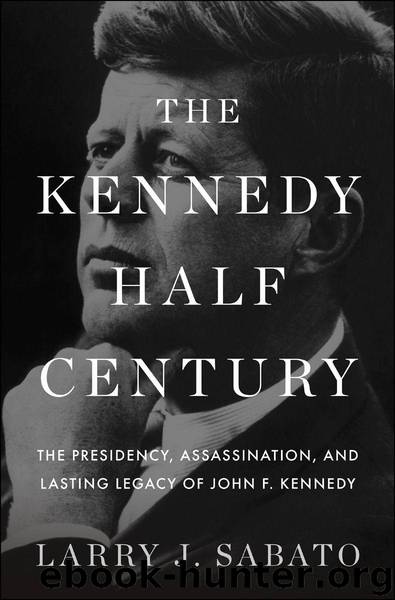
Author:Sabato, Larry J. [Sabato, Larry J.]
Language: eng
Format: epub
Publisher: Bloomsbury Publishing
Published: 2013-10-14T18:30:00+00:00
Nixon’s memory was selective, though. His administration extensively used the FBI, the Internal Revenue Service, and the CIA to serve its political needs just as his predecessors had. The age of the imperial presidency had enabled Kennedy and Johnson to get away with their deeds. Nixon was caught, and his web of lies, deceits, and unconstitutional pretensions during Watergate brought down his presidency in an unprecedented way, through resignation in the face of near-certain House impeachment and Senate conviction. Had John Kennedy lived and if his extramarital entanglements had been exposed, he would probably have been forced to resign. Had Lyndon Johnson won a second full term and continued the Vietnam War as Nixon did, he might have triggered abuse-of-power revelations, too, and been forced to leave office early. But JFK by assassination and LBJ through early retirement avoided that fate.
Nixon believed that his political enemies were behind the Watergate revelations. He pointed to Ben Bradlee, the executive editor of the Washington Post who had been a close JFK confidant, and to Watergate special prosecutor Archibald Cox, who had worked for JFK in 1960 and been recommended for the prosecutor’s role by Ted Kennedy.72 Nixon might have added that his many foes in a heavily Democratic Congress were eager to do their part in his collapse. (JFK and LBJ were fortunate to have had their party firmly in charge of Capitol Hill throughout the 1960s.) Yet for all the assistance and cheerleading that President Nixon’s adversaries gave to his demise, Nixon caused his own downfall, and he was also the man occupying the White House when the hefty bill came due for long-term presidential abuse of power. That bill would have arrived eventually in any event, but Nixon hastened it with his attitudes as well as deeds. “The more successful Nixon became, the more vengeful he became,” noted John W. Dean. “It’s really quite remarkable. Nixon didn’t mellow with his success, he became embittered by it.”
For a short period, mainly in 1972, JFK’s legacy had dimmed because of Nixon’s spectacular foreign policy successes, just as Kennedy’s domestic record was almost completely eclipsed during the 1965 heyday of the Great Society. But Richard Nixon discovered what Lyndon Johnson already knew: In the broad sweep of history, their presidencies were judged inadequate. Nixon and Johnson had much longer lists of achievements, but fundamental personal faults led to policy disasters and, ultimately, their undoing. More than a decade after Kennedy’s death, compared to both his successors, JFK retained the lion’s share of the American people’s affections.
Ironically, as Nixon fought to keep the White House in his final days, he argued that the nation could not endure another failed presidency, specifically citing Kennedy’s assassination and Johnson’s early exit.73 When he resigned, he elevated his handpicked vice president, Gerald R. Ford, to the nation’s highest office.ac Americans immediately recognized that he was a pleasant, uncomplicated man who had none of the neuroses that had troubled LBJ and Nixon. After more than a decade of trauma, citizens welcomed a chance to heal.
Download
This site does not store any files on its server. We only index and link to content provided by other sites. Please contact the content providers to delete copyright contents if any and email us, we'll remove relevant links or contents immediately.
The Secret History by Donna Tartt(19105)
The Social Justice Warrior Handbook by Lisa De Pasquale(12197)
Thirteen Reasons Why by Jay Asher(8921)
This Is How You Lose Her by Junot Diaz(6894)
Weapons of Math Destruction by Cathy O'Neil(6285)
Zero to One by Peter Thiel(5808)
Beartown by Fredrik Backman(5768)
The Myth of the Strong Leader by Archie Brown(5513)
The Fire Next Time by James Baldwin(5454)
How Democracies Die by Steven Levitsky & Daniel Ziblatt(5225)
Promise Me, Dad by Joe Biden(5157)
Stone's Rules by Roger Stone(5091)
A Higher Loyalty: Truth, Lies, and Leadership by James Comey(4967)
100 Deadly Skills by Clint Emerson(4932)
Rise and Kill First by Ronen Bergman(4797)
Secrecy World by Jake Bernstein(4756)
The David Icke Guide to the Global Conspiracy (and how to end it) by David Icke(4724)
The Farm by Tom Rob Smith(4517)
The Doomsday Machine by Daniel Ellsberg(4493)
